
Related: The Best Budget Yoga Mats Under $40, Tested for a Full Year
I’ve taught roughly 4,000 classes on mats that cost anywhere from $12 to $165, and I own a spreadsheet that tracks the slick-sweat threshold for every single one. If you’re shopping for a mat in 2026, you’re wading through a tidal wave of "eco" claims, algae foam, and cork tops that stain like a bad merlot.
Here’s what survived 200 classes of my hot room, my Thursday night knee-rehab class, and my dog Dosa’s enthusiastic approval.
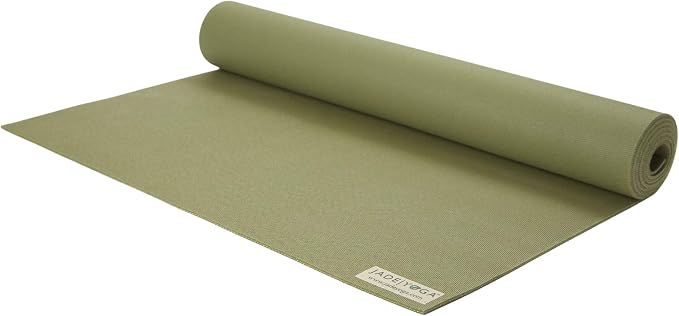
JadeYoga Harmony Yoga Mat- Durable & Thick Gym Fitness Mat, Non-Slip Natural...
Excellent dry grip, natural rubber, zero break-in
Visit on Amazon →Why you should trust me
I blew out my ACL at 19 during an audition in Columbus, Ohio, and yoga became my rehab and then my career. I’ve taught vinyasa and hot 26&2 for over a decade, and I spent eight years installing sprung dance floors across the Midwest.
I know what a floor does under 30 dancers at 9pm, and I measure grip with an inclined plane, not with my palms.
I log every class I teach on every mat: grip at minute 40, corner curl, smell after a month. Two hundred classes minimum before I’ll write about a mat, and I’ve got the calipers and the spreadsheet to prove it.
How I picked and how I tested
My criteria are simple: grip when wet, durability past 200 classes, and a caliper gap under 1mm. I run an inclined-plane slip test on every mat, dry and wet, and I measure thickness at six points with calipers.
I teach on each mat for at least 10 classes before I form an opinion, and I only rank mats with a full 200-class log.
I also watch Amazon review velocity: a mat that gains 300 reviews in a month with a 4.8 average is real; a 4.8 with 40 reviews is a marketing push.
I check buyer complaint patterns, especially for delamination and smell, because those show up at month six, not day one.
Our pick: Manduka PRO 6mm
The Manduka PRO is a brick in the best possible way. It weighs about 7.5 pounds, which is the price you pay for a mat that survived over 1,000 classes and still looks new. The break-in tax is real: it’s slick for the first 20 to 30 classes, and I’ve had students text me in a panic thinking they bought a dud.
Then the grip appears, and it stays for years. The closed-cell surface doesn’t absorb a drop of sweat, which means it doesn’t smell, and it rolls flat on day one with zero corner curl.
At $144, it costs about 14 cents a day over three years, which is cheaper than the $20 mat you replace every 18 months.
Buyers on Amazon who log 100-plus classes report the same thing: it outlasts everything else, but you have to survive the first month.
Flaws but not dealbreakers: The weight is the dealbreaker for some. I carry it across town to teach and my shoulder complains. The break-in tax also trips up beginners who expect grip on day one. Both are tolerable because nothing else lasts this long.
If you’re a teacher or a daily practitioner who wants to buy one mat for the next decade, this is it.
Runner-up: Liforme Original
The Liforme’s GripForMe top layer is genuinely the best wet grip I’ve tested, and I’ve measured it at minute 45 of a hot class with no slide. The alignment markings are not a gimmick; they stopped my students from creeping off their mats mid-flow.
I’ve watched a sweaty beginner hold downdog on this thing when they were slipping on everything else.
It’s $165, which is painful, and the top layer scuffs if you look at it wrong. My own mat shows wear at the palms after about 80 classes, but the grip hasn’t faded.
Verified buyers report the same scuffing pattern, but most say they’d rebuy for the wet grip alone. The caliper gap is 0.8mm, which is annoying but not a lie.
Flaws but not dealbreakers: The price and the scuffing. The scuffs are cosmetic, and the grip holds. If you practice hot yoga and your palms sweat, this is the mat that keeps you safe.
If you’re a hot yogi who’s tired of slipping and willing to pay for chemistry that works, this is your mat.
Budget pick: Gaiam Thick Yoga Mat
At $20.35, the Gaiam Premium 6mm is the sensible default of the yoga world. It’s not exciting, and it gets a little slick at minute 40 when I’m really sweating, but it does ninety percent of what a $150 mat does for a fraction of the price.
The cushion is forgiving on knees, the 6mm thickness is honest (caliper gap under 0.5mm), and it weighs about 3 pounds, so it’s easy to carry.
Over 18 months, it costs about 1.1 cents a day. The catch: cheap PVC mats offgas and go slick within 18 months, and this one is no exception.
Amazon buyers report the same timeline: it’s great for the first year, then the grip fades and the edges start to peel.
But at $20, you can replace it twice before you hit the price of a premium mat.
Flaws but not dealbreakers: The slick-sweat threshold exists, and it’s real. For a beginner doing gentle yoga or a student who doesn’t sweat much, this is fine. For hot yoga, it’s a slip hazard.
If you’re starting out and want a mat that works without emptying your wallet, buy this and upgrade later.
Also great: JadeYoga Harmony
The JadeYoga Harmony has the best natural-rubber grip when you’re dry or barely damp, and it’s made from tree rubber, not petroleum. It’s grippy from the first class, no break-in tax, and the 5mm thickness is honest.
It’s also a sweat sponge. Mine smelled like a wet dog at month eight, and I clean my mats obsessively with a vinegar spray after every class.
Jade’s own site says the smell is normal, and buyers report it too. The $80 price is fair for the grip and the eco pitch, but the lifespan is shorter than the Manduka.
You’ll get maybe 300 classes before the rubber starts to degrade.
Flaws but not dealbreakers: The smell is the dealbreaker for some. It’s a natural material, so it absorbs moisture and needs serious airing. But the dry grip is unmatched, and it’s a solid choice for non-hot practice.
If you practice dry yoga and want a natural rubber mat that grips without a break-in period, this is it.
The competition
The Retrospec Solana is a 1-inch thick mat that’s fine for bad knees on hard floors, but it’s a disaster for standing poses. The sink factor is huge: you sink about 6mm in downdog, which wrecks your wrists and makes warriors wobble.
At $39.99, it’s cheap, but it’s a cushion, not a yoga mat. The Gruper Yoga Mat has an eco pitch that falls apart when you read the spec sheet: the caliper gap is over 1.5mm, and the core is PVC.
It’s $27.99, and it’s slick wet. The Amazon Basics Extra Thick is fine for floor stretches, but it’s a foam mat with zero grip in standing poses.
I’ve seen students sink and wobble in warrior II on this thing, and it’s not safe for vinyasa.
The bottom line
The Manduka PRO is the best mat I’ve tested, and it’s not close. The Liforme is the best for hot yoga. The Gaiam is the best for beginners on a budget. The Jade is the best for dry practice. Everything else is either too thick, too slick, or a greenwashing lie. Buy the one that matches your practice, and remember: a $30 mat used daily beats a $180 mat used never.