Related: How to Clean a Yoga Mat Without Ruining the Top Layer
I have taught long enough to be tired of the word "non-slip" printed on a box with no conditions attached. Every thick yoga mat in this price band claims it. Almost none of them mean it once your hands are wet. So before you buy cushion, buy the right kind of cushion for the floor you actually practice on.
Two disclosures up front. First, this post contains affiliate links, and I make money if you buy through them. Second, my rule is that I only link mats I would hand to a student, which is a different bar than "the mat a brand sent me for free." Everything below is judged on the same four questions I ask in class: does it stay put, does it stay flat, does it cushion the joints that need it, and does it survive a year of Tuesdays.
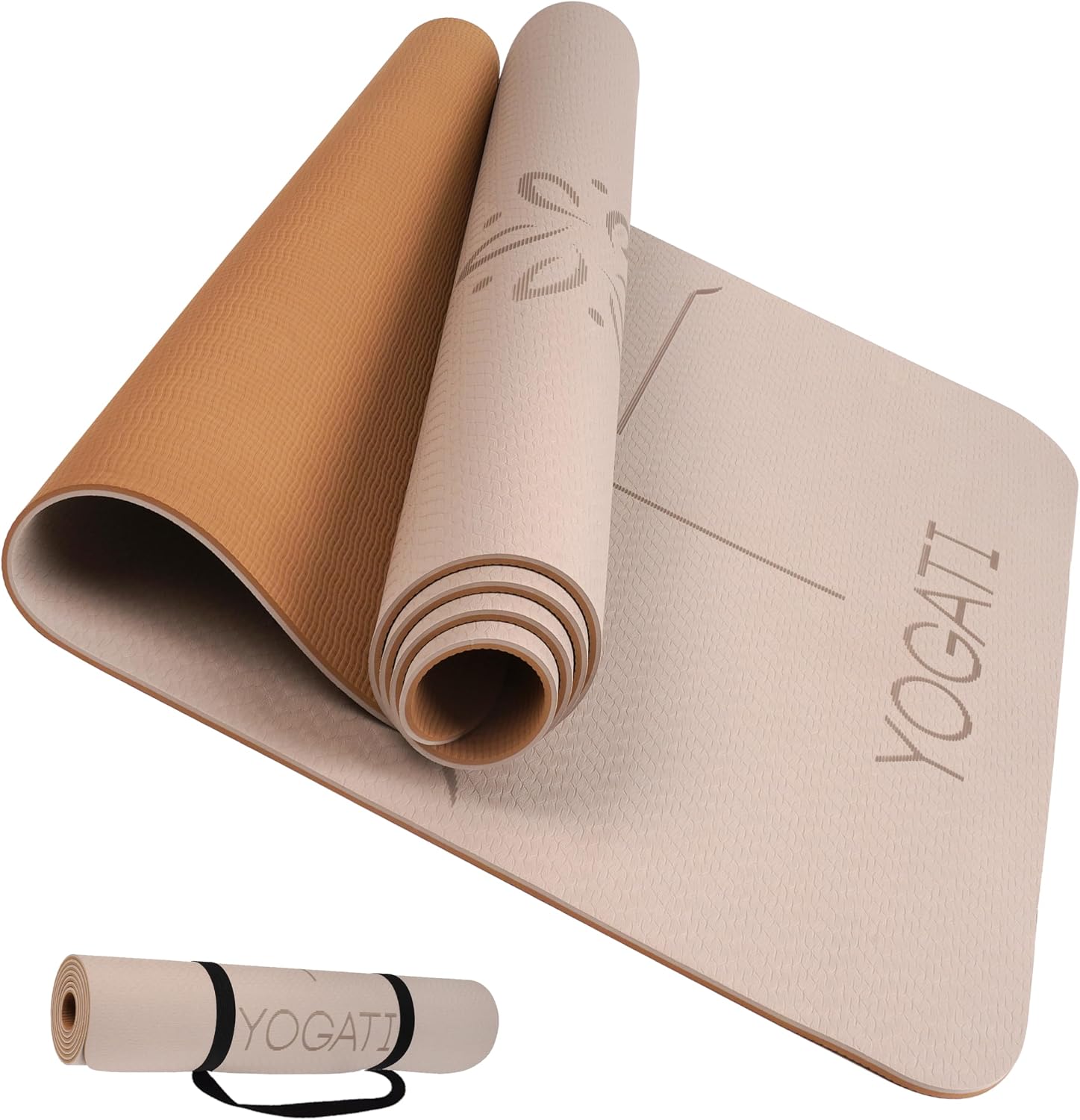
Best overall: YOGATI Yoga Mat with Strap with Alignment Lines
The alignment lines are the reason this one takes the top spot. I spend a surprising amount of class time nudging people back to the center of their mats, because drift is invisible until someone's foot is hanging off an edge in triangle pose. A center line and cross marks give you the same feedback a teacher gives you, and for home practice that is worth more than another millimeter of foam. It also helps in down dog, where hand placement quietly decides whether your shoulders are stacked or your whole plank is crooked.
The strap is included, which matters more than people think. Corner curl and edge lift are how mats get dangerous on a slick studio floor, and a strap keeps the roll tight enough that the ends do not take a permanent set. Colors run brown, pink, and purple, and the mat is pitched at home workouts, pilates, and general fitness, which is exactly how I would use it.
Here is the honest limitation. The word "thick" on the listing is a comfort claim, not a number, and foam grip is a dry-weather grip. I have taught enough classes on closed-cell foam mats to know the pattern: they hold fine through a slow flow and start to feel greasy somewhere in the second half of a hot class. If you sweat heavily, budget for a towel and expect to use it. If you practice at home in a normal room, this mat will feel secure, cushion your knees, and roll back up without a fight.
Best value: CAP Barbell 1/2-Inch High Density Exercise Yoga Mat with Strap
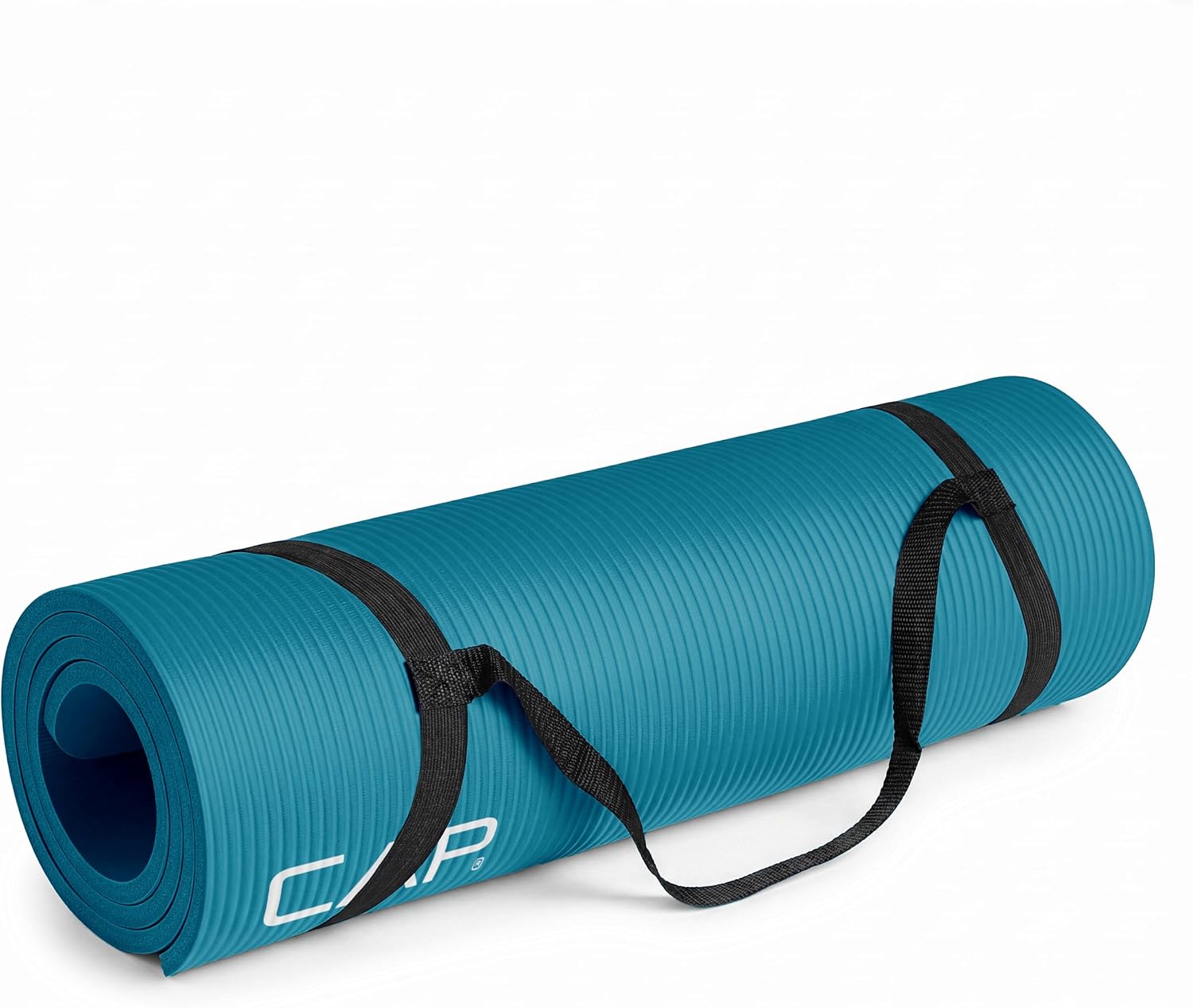
Density beats thickness, and this is the mat that proves it. Half an inch of dense foam gives you a firm surface that does not swallow your palms in plank or wobble under you in warrior two. Soft mats feel luxurious in seated poses and terrible in standing ones, because every millimeter of compression is a millimeter your ankle has to compensate for. The high density here keeps the sink factor low, which is why I would hand this to a beginner learning balance before I would hand them a pillow.
It comes with a strap and comes in multiple color options, so it is easy to keep track of whose mat is whose in a shared house. It is also the most versatile of the four for non-yoga work: floor stretching, core work, physical therapy homework, and the kind of mat-and-dumbbell session that happens in a spare bedroom.
What you give up is cushion. If you have a knee or hip history and you practice on tile or concrete, half an inch of firm foam is not enough padding, and no amount of density fixes that. This is the mat for someone whose joints are fine and whose balance needs a stable floor.
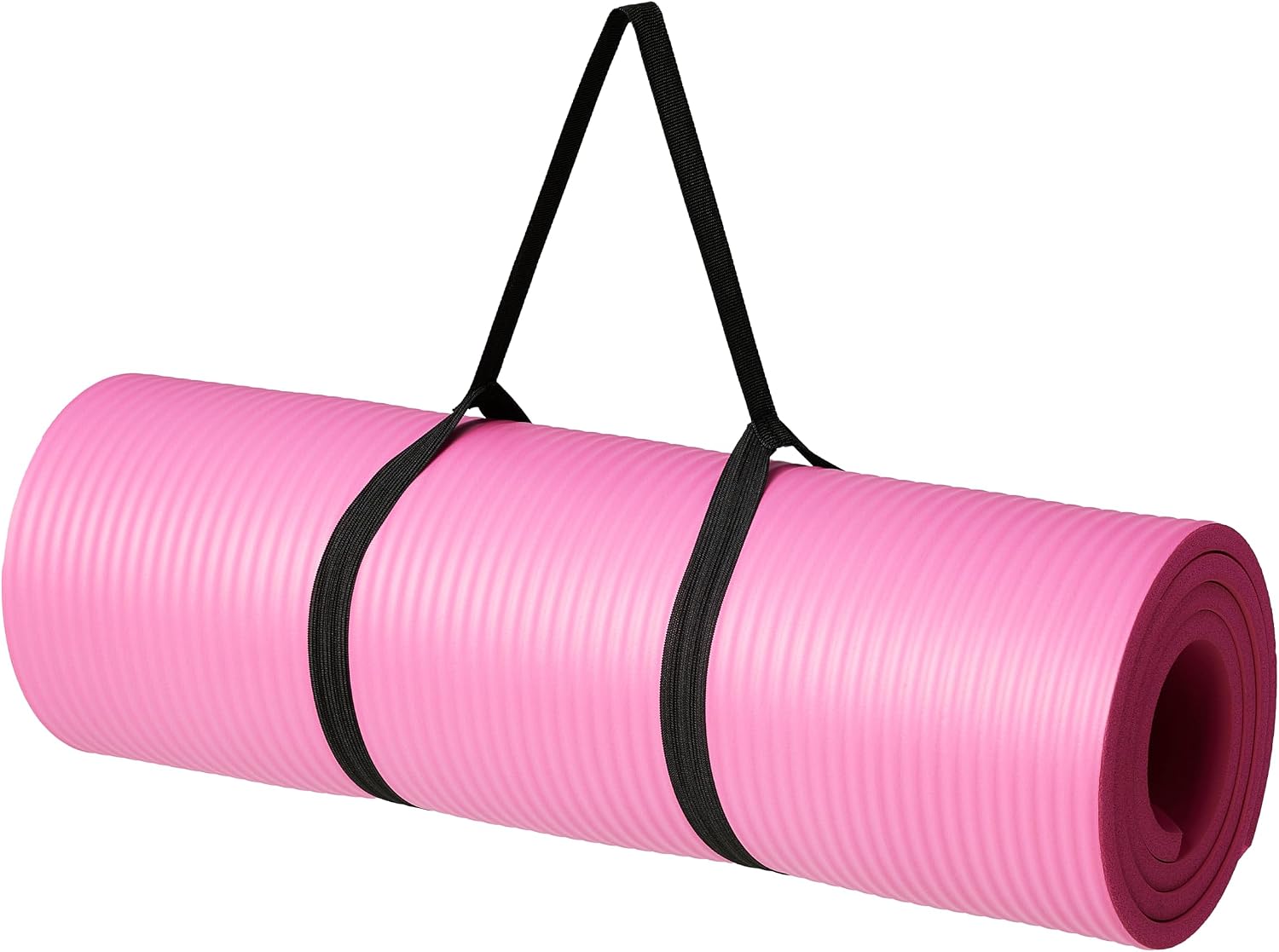
Best cushioned starter mat: Amazon Basics Extra Thick Exercise Yoga Mat with Carrying Strap
This is the mat I would tell a nervous beginner to buy, and I say that knowing it is the least interesting product on the page. It is extra thick, so sits bones stop aching in seated forward folds, knees stop complaining in child's pose, and the whole first month of a home practice feels less like a punishment. The carrying strap makes it portable enough to actually take to a class, which is the only test that matters.
The tradeoff is the same one every cushioned mat makes. Extra thickness means extra compression, and compression is what makes standing balances feel vague. If you are working on tree pose, you want firm, not plush. If you are working on touching your toes without your back hurting, you want plush. Most beginners are in the second category, and there is no shame in buying the mat that matches the body you have right now.
One thing I would check on day one: whether the mat lies flat after a few hours unrolled. A mat that keeps a memory of the tube will lift at the corners, and lifted corners are how people trip. Roll it the other way, leave it flat overnight, and give it a week before you judge it.
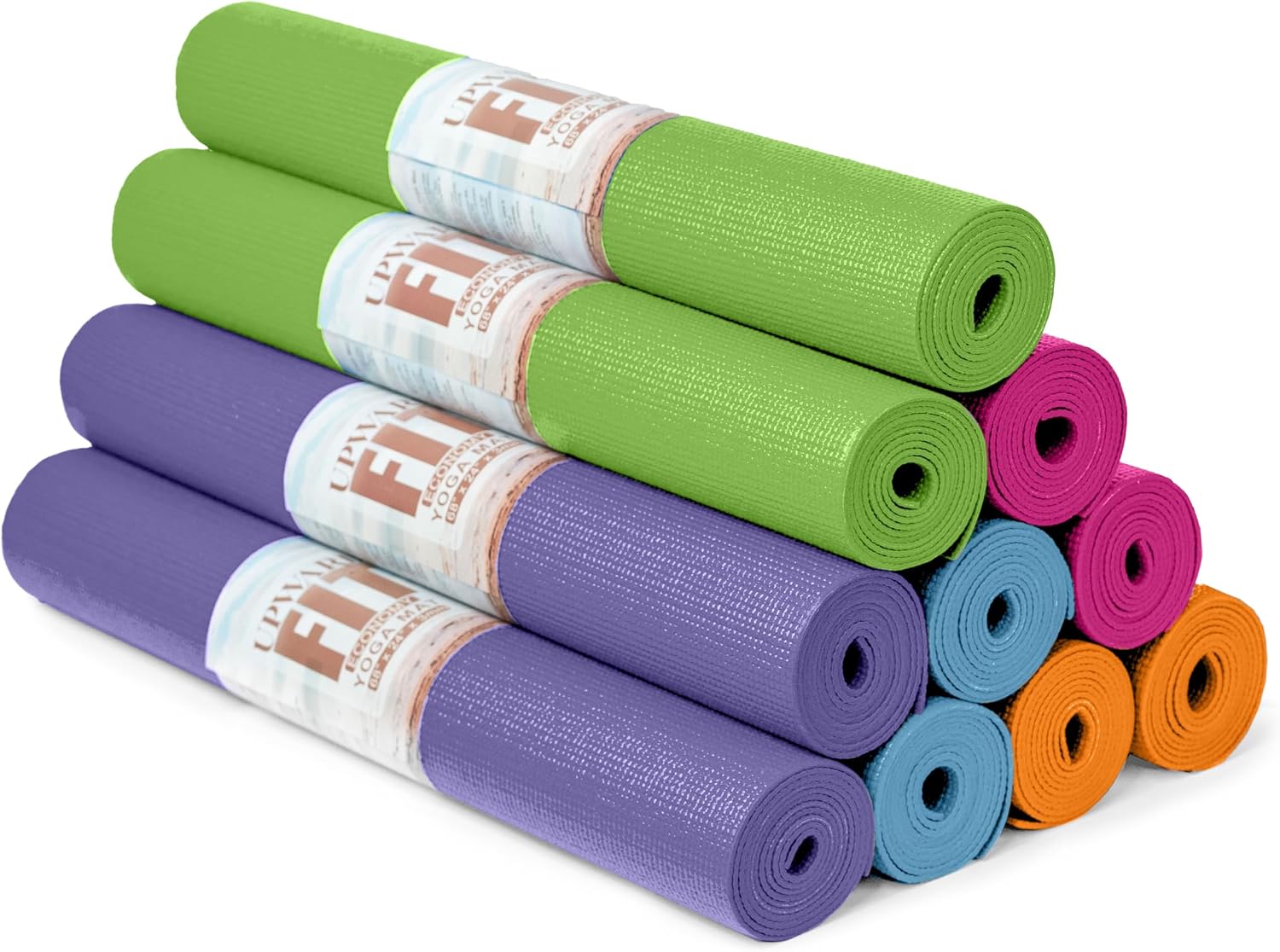
Best for studios and shared spaces: Economy 3mm Bulk Yoga Mats, 10 Pack, 68x24in
This is not a mat for one person. It is a mat for a room full of people, and it solves a problem that individual mats cannot: consistency. Ten mats, sixty-eight by twenty-four inches, three millimeters thick, all identical. When every student in the room is on the same surface, nobody is fighting a spongy mat in standing poses while the person next to them balances on something firm.
Three millimeters is thin, and thin has real advantages. You feel the floor, which is exactly what you want when you are learning to balance, and ten of them stack in a corner without turning into a foam mountain. They are also light enough to carry in armfuls to a park, a gym, a retreat, or a school assembly, which is where bulk packs earn their keep.
The honest caveat is cushion. There is not much of it, so this is not the mat for a student with a knee history on a concrete floor. It is also a shared mat, which means hygiene is your job, not the mat's. Wipe both sides after class, rotate which mats get used, and retire the ones that start to peel. Ten thin mats that get cleaned beat one expensive mat that gets borrowed and never wiped.
How I judge a mat before I recommend it
The method is boring and it is the same every time. Calipers first, at six points including the thinnest edge, because the gap between the number on the box and the number in my hand is a character test. A luggage scale next, because weight predicts whether you will actually carry the thing to class. Then the inclined-plane slip test, dry and wet, where I raise a weighted board until it slides and record the angle. Grip is a chemistry problem, not a texture problem, and the wet number is the one that decides whether a mat belongs in a hot room.
Then I roll it out and watch for mat drag: corner curl, edge lift, the slow walk a mat does across a smooth floor when it never fully relaxes. Finally, the number nobody wants to hear. I want two hundred classes on a mat before I rank it. The mats here are budget and mid-range workhorses, and I am judging them on whether they meet the bar for the job they are built for, not on whether they beat a mat that costs six times as much.
What the specs do and do not tell you
Thickness is a comfort spec, not a grip spec. Every mat on this page advertises some version of thick, and only one of them gives you an actual number: half an inch, or three millimeters in the bulk pack. When a listing says thick without a number, what you are really buying is a category, and the category is "more cushion than a travel mat."
Alignment lines are a genuine feature, not decoration. They substitute for a teacher's eye, and they cost nothing extra on a mat that already has them. If you practice alone, prioritize markings.
Straps are mat insurance. They keep the roll tight, they keep the corners from setting, and they are the difference between a mat you bring to class and a mat you leave in the car.
Material matters more than any of it. Foam grips when dry. Foam loses grip when wet. That is the whole story for this price band, and it is why I keep saying the word towel.
Yoga mat comparison table
| Mat | Thickness as listed | Comes with | Best for | Price |
|---|---|---|---|---|
 Visit on Amazon → Visit on Amazon →YOGATI Yoga Mat with Alignment Lines |
Thick, no number listed | Carry strap | Home practice, pilates, learning placement | $22.99 |
| <img src="/images/products/B0DG3WYD54.jpg" alt="CAP Barbell 1/2-Inch High Density Exercise Yoga Mat with Strap | Multiple Options" width="340" style="border-radius:8px;max-width:340px;width:340px;height:auto;max-height:420px;object-fit:contain"> CAP Barbell High Density Exercise Yoga Mat |
1/2 inch | Carry strap | Standing poses, balance, floor work |
 Visit on Amazon → Visit on Amazon →Amazon Basics Extra Thick Exercise Yoga Mat |
Extra thick, no number listed | Carrying strap | Knees and sits bones, first mat | $22.49 |
 Visit on Amazon → Visit on Amazon →Economy 3mm Bulk Yoga Mats, 10 Pack |
3 mm | Ten mats | Studios, classes, events, schools | $89.99 |
A note on the thin end of that table. Three millimeters is a floor-feel mat, and floor feel is a skill. If you have never practiced on anything thinner than a pillow, the first class on a thin mat will feel like the floor got closer. It did. That is the point.
Should you buy the YOGATI mat with alignment lines?
Yes, if your practice happens at home and you want the mat to do some teaching. The lines are the feature, the strap makes it portable, and the cushion handles knees on hardwood. Just go in with realistic expectations about grip once you are sweating. Foam is foam, and a towel solves what the surface cannot.
Should you buy the CAP Barbell 1/2-Inch High Density mat?
Yes, if you want firm over plush. This is the mat for standing poses, balance work, and anyone who has ever felt seasick in warrior two on a soft surface. It travels with a strap and it holds up to non-yoga floor work. Skip it if your knees need real cushion on a hard floor, because density is not padding.
Should you buy the Amazon Basics extra thick mat?
Yes, for a first mat or a body that needs mercy. Extra thickness is the fastest way to make a home practice comfortable enough to repeat, and the carrying strap means it can leave the house. Accept the compression tradeoff in balances and you will be happy with it for years.
Should you buy the bulk 10-pack of 3mm mats?
Yes, if you are buying for a group rather than a person. Ten identical thin mats is exactly what a studio, a school program, or a retreat needs, and thin mats stack, travel, and store without drama. Buy them for the room. Buy one of the cushioned mats above for the student with the bad knee.