Related: How Much Cushion Your Knees Actually Need in a Yoga Mat
I teach vinyasa in Portland, Oregon, and the question I get after almost every class is the same one: what mat should I buy if my knees hurt? That question is why this post exists. Thick yoga mats are the answer most people land on, and they are also where a lot of people go wrong.
Disclosure first, because it belongs first: the links in this post are affiliate links, and I earn a commission if you buy through one. No brand paid for a placement here, and nothing below is ranked by who pays.
I spent eight years installing sprung dance floors and gym rubber in studios across the Midwest before I ever taught a class, and that job taught me the sentence that should be printed on every mat box: thickness and grip are two different problems. A half inch of foam that slides is more dangerous than a thin mat that grips, because the cushion gives you confidence your traction has not earned. Cushion is not grip.
So this is a guide to thick yoga mats, plus one piece of gear that is not a mat at all but belongs in the same conversation, a foam balance pad. Four products, four jobs, and a reference table at the end for the people who read spec sheets the way I do.
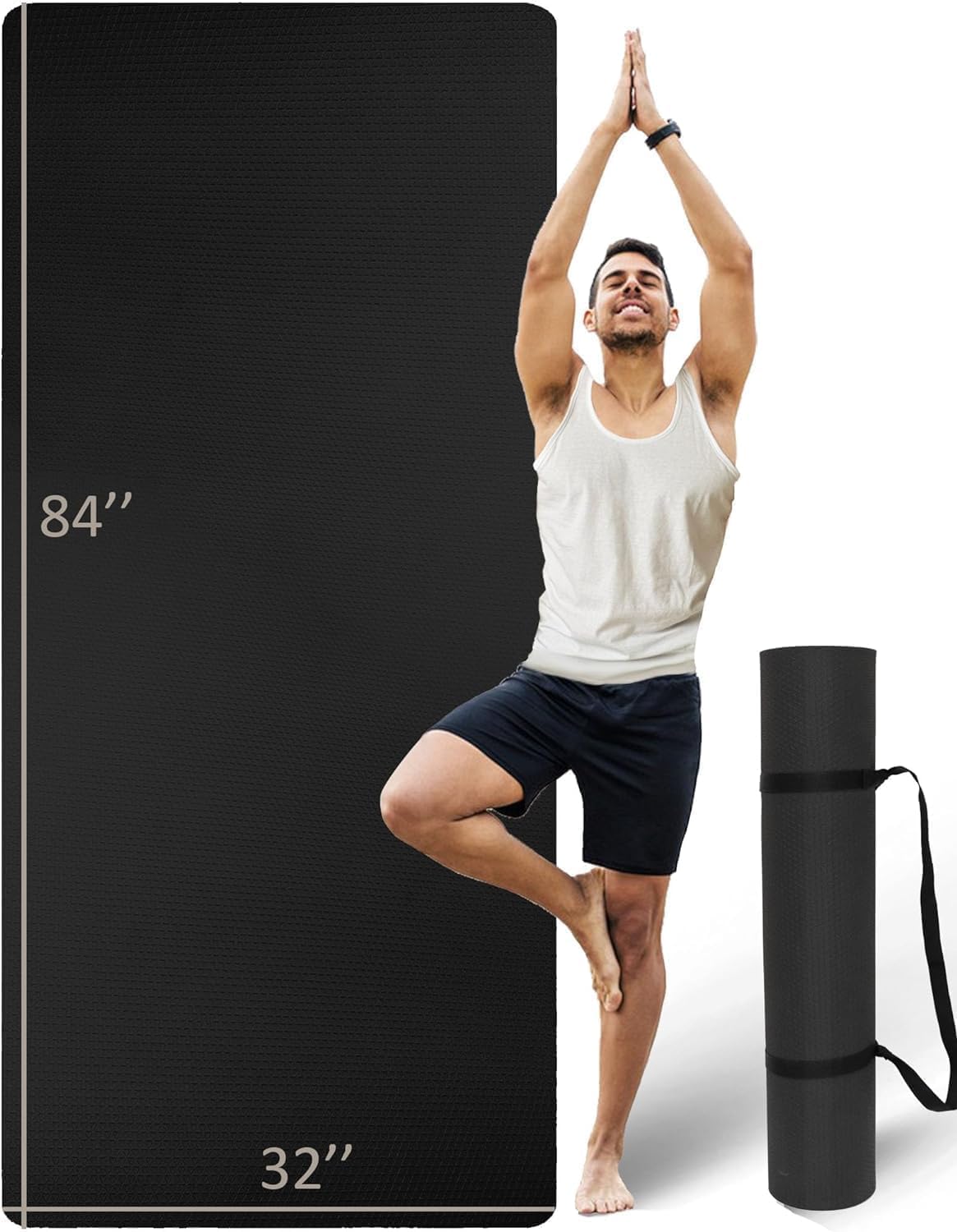
Best Overall: Extra Long and Wide Thick Yoga Mat for Tall Men and Women
The listed size is 84 by 32 inches and the listed thickness is 7mm, which makes this the oversized option in this group. If you are over roughly 5 foot 10, or if you have broad shoulders, a standard 24 inch mat stops being a mat and becomes a suggestion. Your hands land off the edge in downdog. Your heels hang off in a wide-legged fold. You spend the class adjusting instead of breathing, and adjusting is not a practice.
The top layer is TPE, a closed-cell foam that does not need the break-in period natural rubber does. The double-sided non-slip texture is the part I care about most, because a mat is only as good as its top surface at minute 40 of a warm room, and a textured TPE surface holds better when damp than a smooth PVC one does. The included strap is basic, and it works, and an 84 inch mat is a lot of mat to carry without one.
What you give up is ground feel. Seven millimeters is a real distance between your foot and the floor, and standing balances get harder, not easier, because your ankle has to work harder to find the ground. If your practice is mostly standing poses and your joints are fine, buy something thinner. If your knees, hips, or wrists are the reason you are shopping, this is the one I would point you to first.
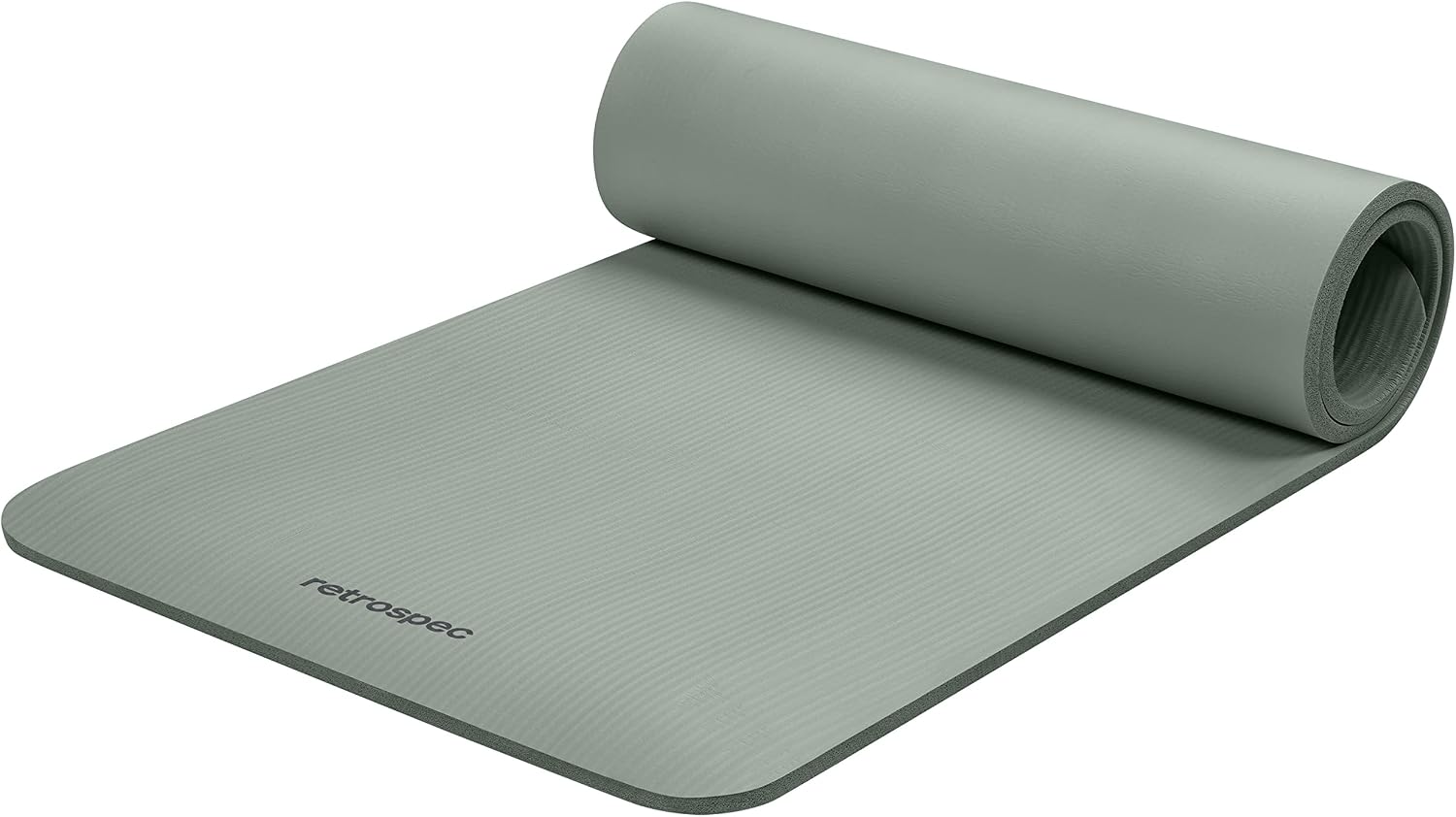
Best Value: Retrospec Solana Thick 1/2in Non-Slip Workout Mat
The Solana is the thick mat I recommend to beginners more often than any other, and it is the sensible default of the category. It lists at a half inch thick and 72 by 24 inches, which is a standard-length mat with genuine cushion, and it comes with a nylon strap for carrying.
Two things make it a good first mat. The first is that it sits at the bottom of this group on price, which matters more than people admit, because the best mat in the world is the one you actually roll out on a Tuesday, and a mat you are afraid to scuff is a mat that stays in the closet. The second is that it is BPA free and easy to clean, so it wipes down with a damp cloth instead of needing a full bath and a two-day dry on the shower rod.
The honest limitation is the one that comes with every thick foam mat. It is a cushion, not a traction device. On a smooth studio floor it stays put for most people. If you sweat heavily in a hot room, or if you practice on hardwood with a strong warrior two, budget for a mat towel or a thin grippy layer underneath. That is not a knock on this mat. It is what half an inch of foam does, and any brand telling you otherwise is selling you a word, not a surface.
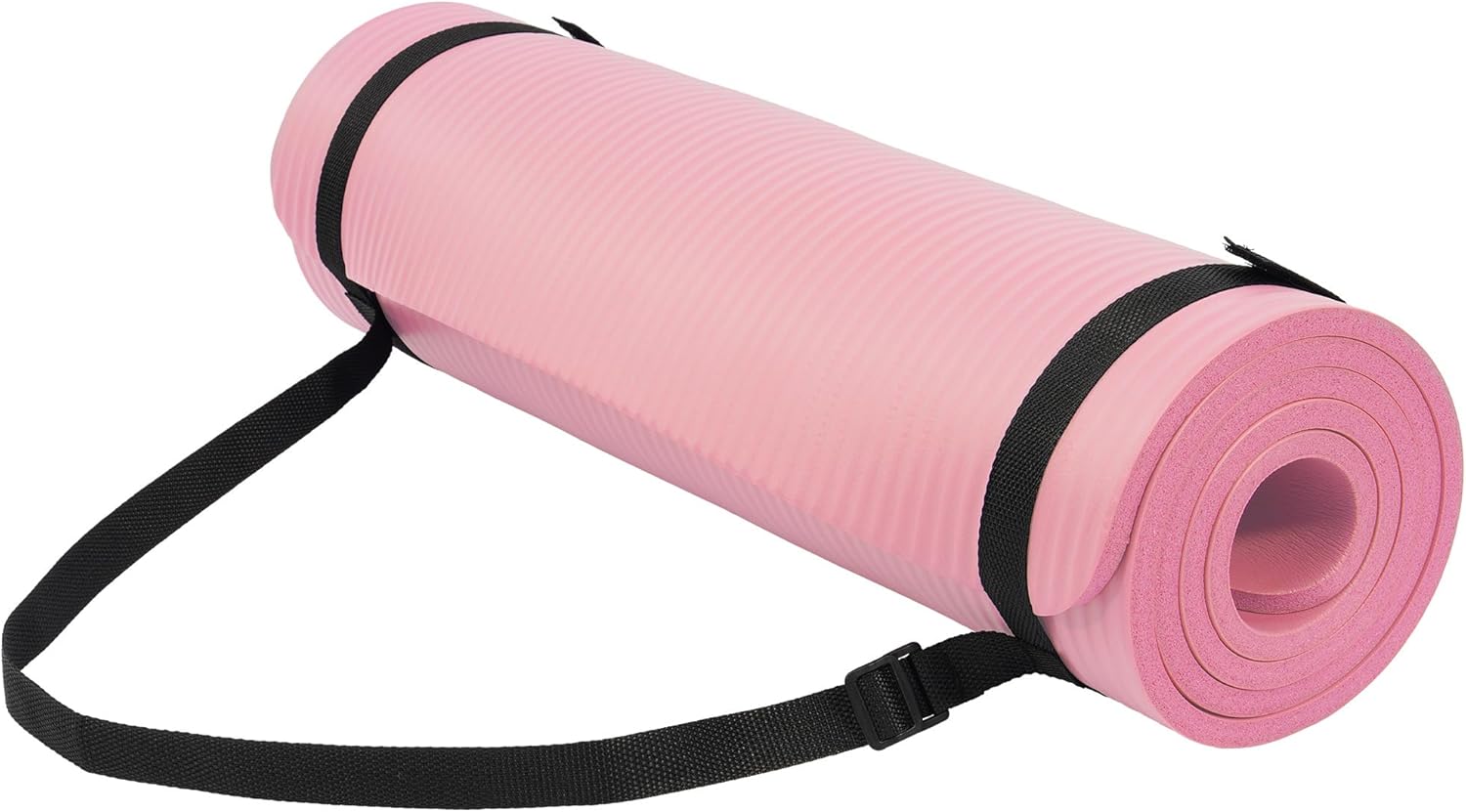
Best Budget: Fitvids 1/2-inch Thick High Density Exercise Yoga Mat
If the Solana is the beginner default, the Fitvids is the budget default. It also lists at a half inch thick, it also ships with a carrying strap, and it does the same basic job: a cushioned surface for stretching, floor work, and the kind of home practice that happens on a rug in a living room where the floor underneath is unforgiving.
Where it earns its place is in the non-yoga uses. This is the mat I would hand someone who wants cushion for a plank series, for physical therapy homework, or for stretching on a basement floor, and who does not want to spend much to find out whether the habit sticks. High density foam at this thickness holds its shape better than the cheap open-cell stuff that packs down into a pancake within a month.
What it is not is a hot yoga mat. A smooth surface, plus a half inch of foam, plus sweat is the exact combination that made me start testing mats properly in the first place. Buy it for dry practice and floor work and you will be happy with it for years.
Best for Knees and Balance Work: StrongTek Foam Balance Pad
This is not a mat, and that is exactly why it belongs here. The StrongTek pad is a 15.8 by 13 by 2 inch block of high density TPE foam, and it does two jobs a thick mat cannot do.
The first job is kneeling and seated work. If your knees complain in a low lunge, or your sit bones complain in a long seated forward fold, a two inch pad under the knee or the seat changes the angle and takes the pressure off, and it does it without making the rest of your practice unstable, because you move the pad rather than the mat. That is the whole argument for a pad over a thicker mat: targeted cushion where you need it, firm ground everywhere else.
The second job is balance training, which is the opposite of what thick yoga mats are good at. Dense foam under one foot forces the ankle and the small stabilizer muscles around it to work, which is the same reason I am suspicious of an inch of foam under a warrior pose. It is non-slip on both sides, so it stays where you put it on hardwood. Use it for single-leg work, for ankle rehab, and for the kneeling portions of a class your knees have been negotiating with for years.
How I judge a thick mat
I start with the top surface, not the thickness. The top layer decides everything about whether you slide, and it is the spec that almost no box bothers to explain. PVC is durable and cheap and gets slick when it is wet. TPE is lighter and grips better damp. Natural rubber has the best dry grip in the business and the shortest temper in a hot room, because it soaks up sweat and holds onto the smell.
Then I look at the thickness claim and treat it as a claim. Almost every brand rounds up, and the number that matters is not the thickest point but the thinnest, because that is where your knee actually lands. A mat that lists at a half inch and delivers a little less at the edges is not lying about the middle. It is just not telling you the whole story.
Then the unglamorous stuff. Corner curl, which is what makes a mat dangerous on a smooth studio floor, because a lifted edge catches a heel. Offgassing, which is the smell test at week one and again at week four, since a mat that still smells like a tire in month two is a mat you will stop unrolling. Carry weight, because durability and portability are fundamentally opposed and nobody wants to admit it. And cleanability, because a mat you cannot wipe down is a mat you will replace.
Analysis: what the numbers on the box actually tell you
Size is the most ignored spec in the category and the one that changes the most poses. A 72 by 24 inch mat is the industry standard, and it fits a body up to a certain height and shoulder width. Past that, you are renting floor space from the studio and hoping nobody steps on your hand. The 84 by 32 inch mat in this group exists for exactly that reason, and if you are tall, the extra surface is worth more than any amount of cushion.
Thickness is where buyers get fooled, but not in the direction they expect. The problem with a thick mat is rarely the thickness itself. It is what the thickness does to your balance. Every millimeter of foam between your foot and the floor is a millimeter of information your ankle does not receive. My dancer's knees want the cushion. My flooring brain knows the cost. If you are working on standing balances, a thick mat will slow you down, and that is not a defect, it is physics.
Material is the third spec and the one with the longest tail. TPE and PVC are both petroleum-derived, and the difference between them is weight, grip when damp, and how they age. Natural rubber grips better and degrades faster in a hot room. Cork grips wet better than almost anything and stains like a cutting board. There is no free lunch in this category. There is only the tradeoff that matches your practice.
Which is why the balance pad in this guide is not a compromise pick. It is the correct answer to a specific problem. If your knees hurt in two poses out of forty, you do not need a thicker mat under all forty. You need two inches of foam under the two.
The thick mat reference table
This is the table I keep when students ask me to compare specs in the parking lot after class. Every number in it comes from the listing, not from a tape measure, and that distinction is worth remembering.
| Mat | Listed thickness | Listed size | Who it is for |
|---|---|---|---|
 Visit on Amazon → Visit on Amazon →Extra Long and Wide Thick Yoga Mat |
7mm | 84 x 32 in | Tall and broad practitioners |
 Visit on Amazon → Visit on Amazon →Retrospec Solana |
1/2 in | 72 x 24 in | A first mat with real cushion |
 Visit on Amazon → Visit on Amazon →Fitvids High Density Mat |
1/2 in | Not stated in the listing | Budget mat, stretching, floor work |
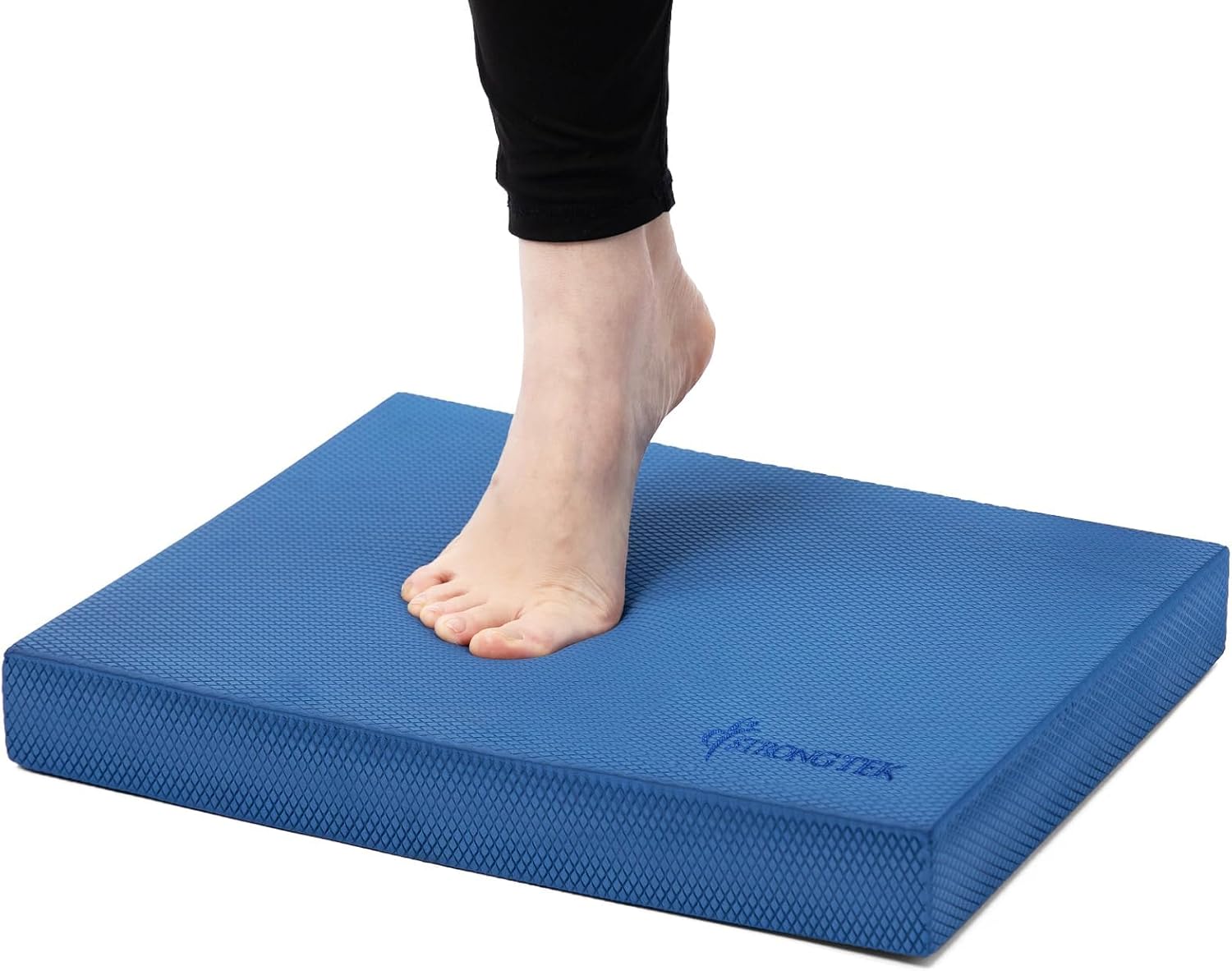 Visit on Amazon → Visit on Amazon →StrongTek Foam Balance Pad |
2 in | 15.8 x 13 in | Knees, seated work, balance drills |
Read that table the way I do and the shape of the decision shows up fast. Two mats list at the same thickness, one mat is dramatically bigger, and one item is not a mat at all. Those are three different answers to three different problems.
Stacking a pad under a mat
You can put the balance pad on top of a mat rather than beside it, and for seated work that is often the right call, because the pad adds height without changing the surface your hands are on. Do not stack it under a standing pose. Two inches of dense foam plus half an inch of mat foam under one foot is a wobble you will feel in your hip by the end of class, and not in a good way.
Should you buy the Extra Long and Wide Thick Yoga Mat?
Yes, if you are tall, broad shouldered, or shopping because your knees hurt. The listed 84 by 32 inch surface and 7mm of cushion solve the two problems a standard mat creates for larger bodies, and the double-sided TPE surface is the kind of top layer that holds up in a warm room instead of going glassy.
The tradeoff is honest and you should accept it going in. Standing balances will be harder on 7mm than they would be on 4mm, and that is the price of cushion. Buy it for the length, the width, and your joints. Do not buy it expecting it to fix your balance. No mat does that.
Should you buy the Retrospec Solana?
Yes, for a first mat with real cushion. It lists at a half inch thick and 72 by 24 inches, it comes with a nylon strap, and it cleans up with a damp cloth, which is more than I can say for the rubber mats that need a full bath and a two-day dry.
Just know what you are buying. A half inch of foam is cushion, not grip. If you sweat heavily, add a towel. If you practice on a slick studio floor and you are not sure, buy a mat towel at the same time and thank yourself later. That combination will outperform a mat that costs five times as much and slides.